
Federal Estate Tax & California Estate Tax: What California Residents Should Know
Estate taxes are often misunderstood. Many people assume that an estate will owe taxes simply because someone dies or because substantial assets pass to children or other beneficiaries.
For most California families, that is not the case.
California currently does not impose its own estate tax or inheritance tax. However, sufficiently large estates may still be subject to the federal estate tax.
What is the Federal Estate Tax Exemption?
The federal estate tax applies only when the value of a person’s taxable estate, together with certain lifetime taxable gifts, exceeds the available federal estate and gift tax exemption.
In 2026, the federal basic exclusion amount is $15 million per person.
In simplified terms, this means that an individual may generally transfer up to $15 million during their life or at their death without incurring federal estate or gift tax, assuming the person has not previously used a portion of the exemption through taxable lifetime gifts.
For example, if an unmarried California resident dies in 2026 with an $8 million estate and has not previously made substantial taxable gifts, the estate would generally fall below the federal estate tax exemption.
By contrast, an estate exceeding the available exemption may be subject to federal estate tax. Federal estate tax rates are progressive and can reach 40% at the highest levels.
Does California Have an Estate Tax?
Currently, California does not impose a separate estate tax on estates simply because the decedent lived in California.
California also does not currently impose a general inheritance tax on beneficiaries merely because they receive an inheritance.
An inheritance itself is generally not treated as California taxable income to the beneficiary. However, income later generated by inherited property—such as interest, dividends, rent, or taxable gains—may be subject to income tax.
Estate Tax is Different from Income Tax and Property Tax
The absence of a California estate tax does not mean that every transfer at death is tax-free in every respect.
Other tax considerations may still arise, including:
Federal estate tax for larger estates;
Income taxes generated during estate or trust administration;
Capital gains taxes when inherited property is later sold;
Property tax reassessment issues involving California real estate; and
Generation-skipping transfer tax when assets pass to grandchildren or more remote generations.
In particular, California real property may raise separate property-tax issues under Proposition 19. Those rules are distinct from the federal estate tax and should be considered separately when planning transfers of homes, rental properties, or family farms.
The Estate Tax Exemption can Change
The federal estate tax exemption has changed substantially over time. That is one reason estate plans should be reviewed periodically, particularly for individuals with significant assets.
For comparison, the federal estate tax exemption for selected years over approximately the last 20 years was:
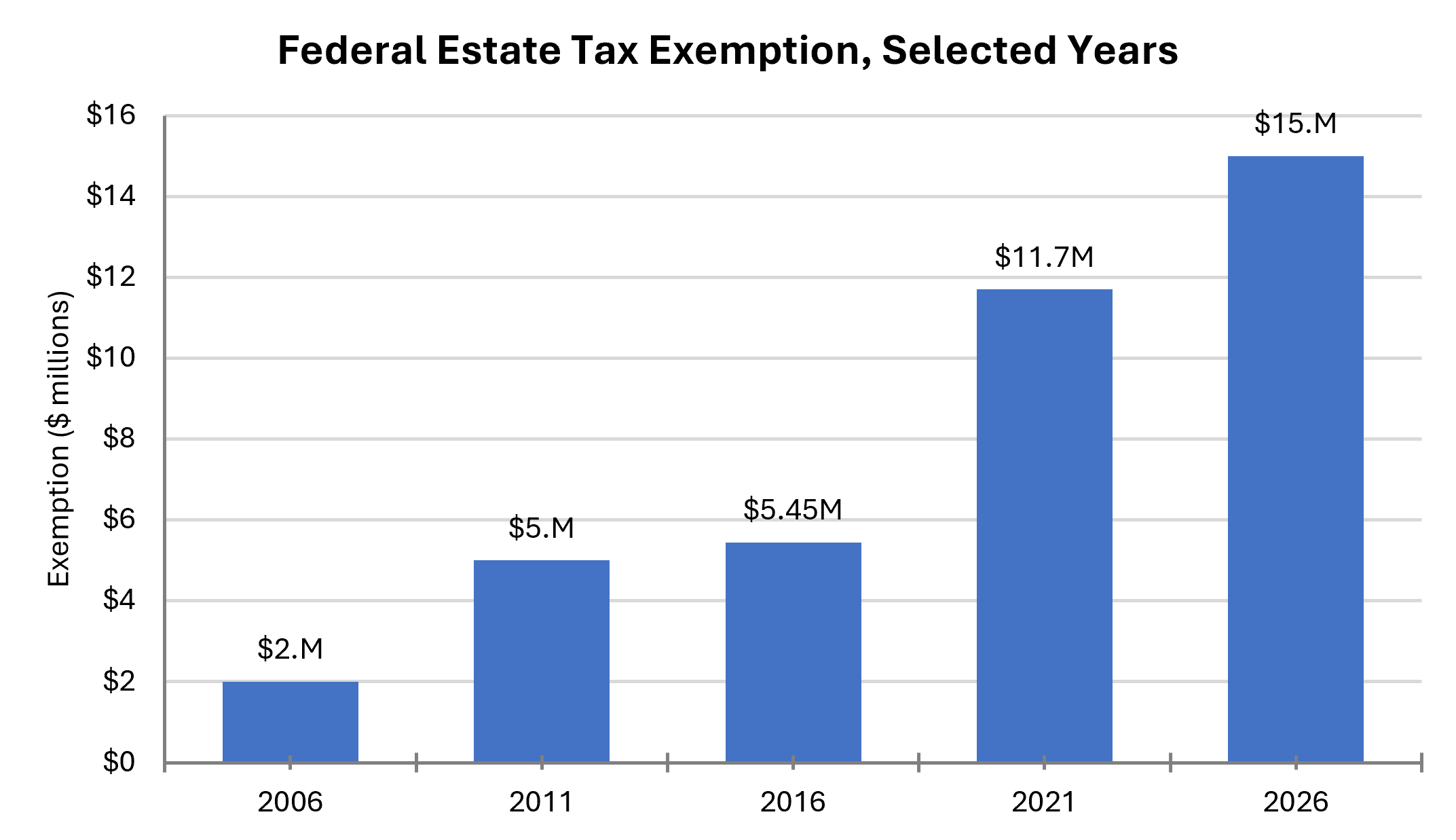
The change has been significant. An estate valued at $10 million, for example, would have been well above the federal exemption in 2011 but would fall below the basic exclusion amount for a decedent in 2026.
The exemption increased from $13.99 million in 2025 to $15 million in 2026. Current federal law provides for the $15 million exemption to be adjusted for inflation in future years.
Because Congress can change the estate tax laws, the exemption applicable when an estate plan is created may be very different from the exemption in effect when a person ultimately dies. Changes in asset values can also affect the analysis. Appreciation in real estate, investments, business interests, and other assets may cause an estate that was once well below the exemption to approach or exceed it.
For that reason, individuals with substantial estates should periodically review their estate plans considering both changes in federal law and changes in their financial circumstances.